Twinview Objects
Landing Page
Landing Page
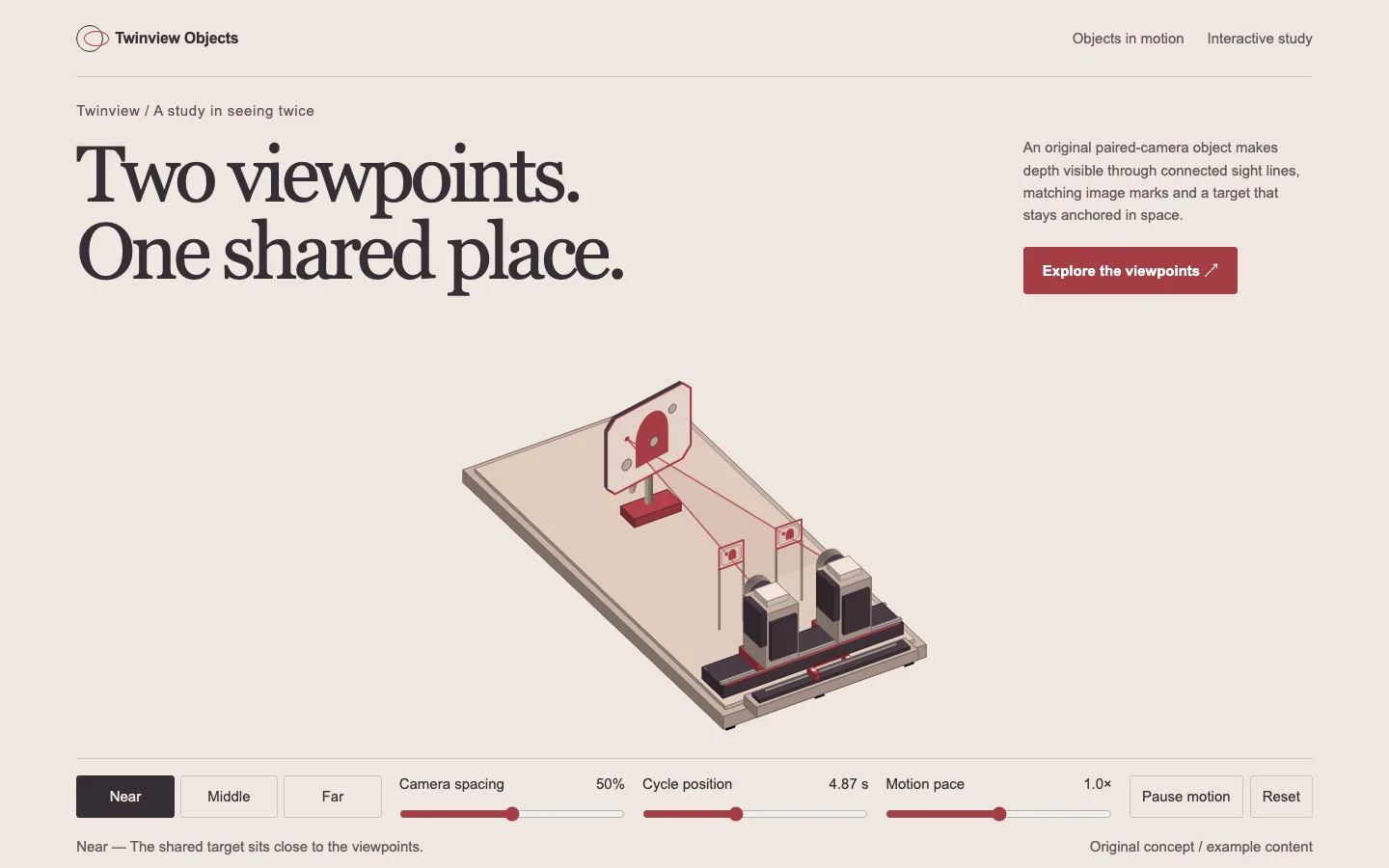
An asymmetric source mosaic maps into a second complete curved mosaic through a bounded complex disk automorphism, linking exact cell boundaries, paired tangent crosses and an eccentric control instrument.
Ready to paste
Copy it as written, then change the content and brand details inside your coding agent.
ORIGINAL DESIGN BRIEF — Diskcraft Bureau

Create a polished animated landing page for this fictional brand.

EXACT COPY
Brand: Diskcraft Bureau
Eyebrow: Diskcraft / Systems for a changing mark
Heading with intended line break: Keep the angles. / Change the emphasis.
Body: A pair of crafted mosaic panels reveals an exact disk transformation through connected marks, preserved local angles and a changing spatial emphasis.
Main action: Shape the emphasis
Three choices: East / Northwest / Southwest
Palette: background #EEE9DB; foreground #243A3E; muted text #53686A; accent #A76B27.

ART AND GEOMETRY
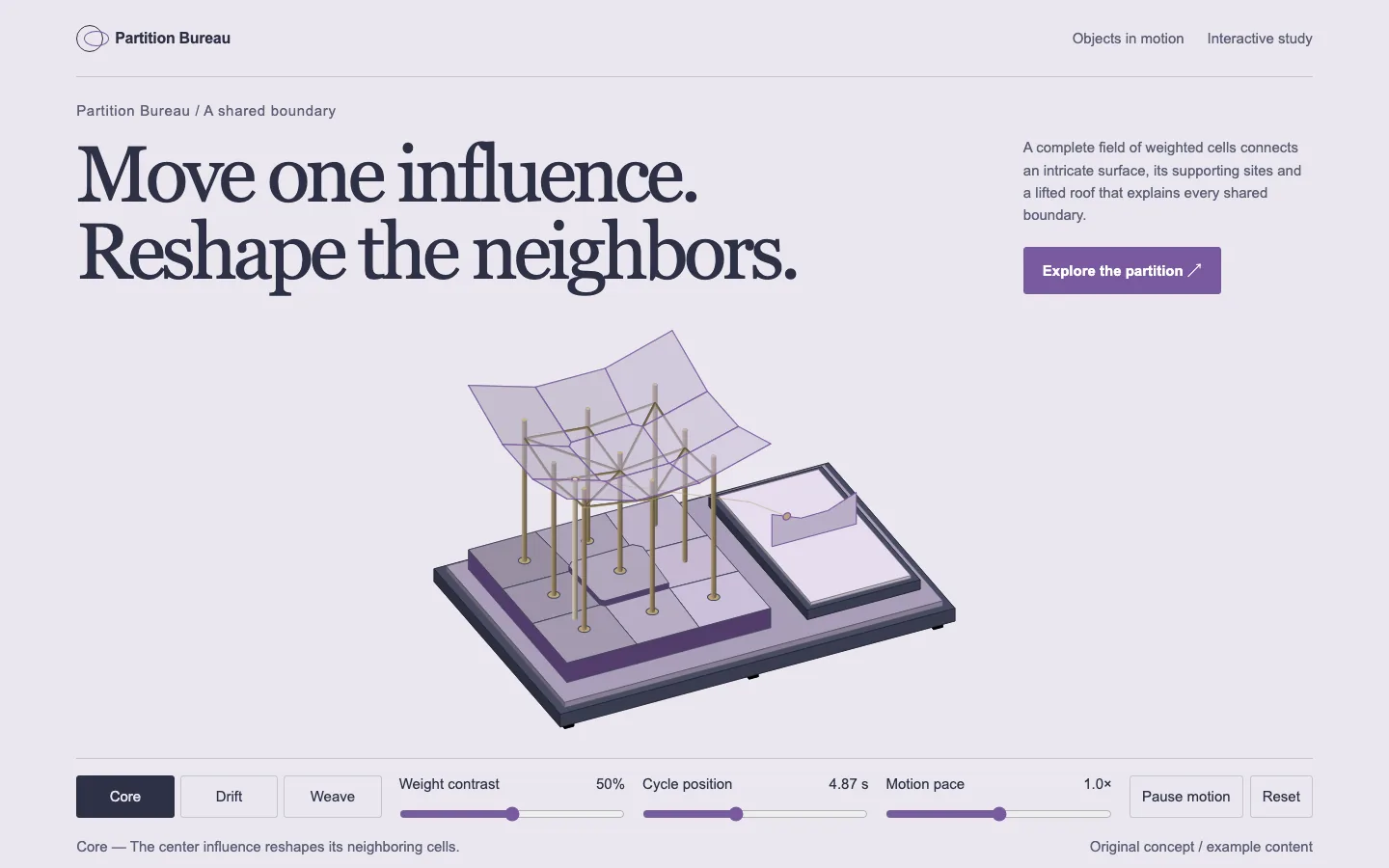
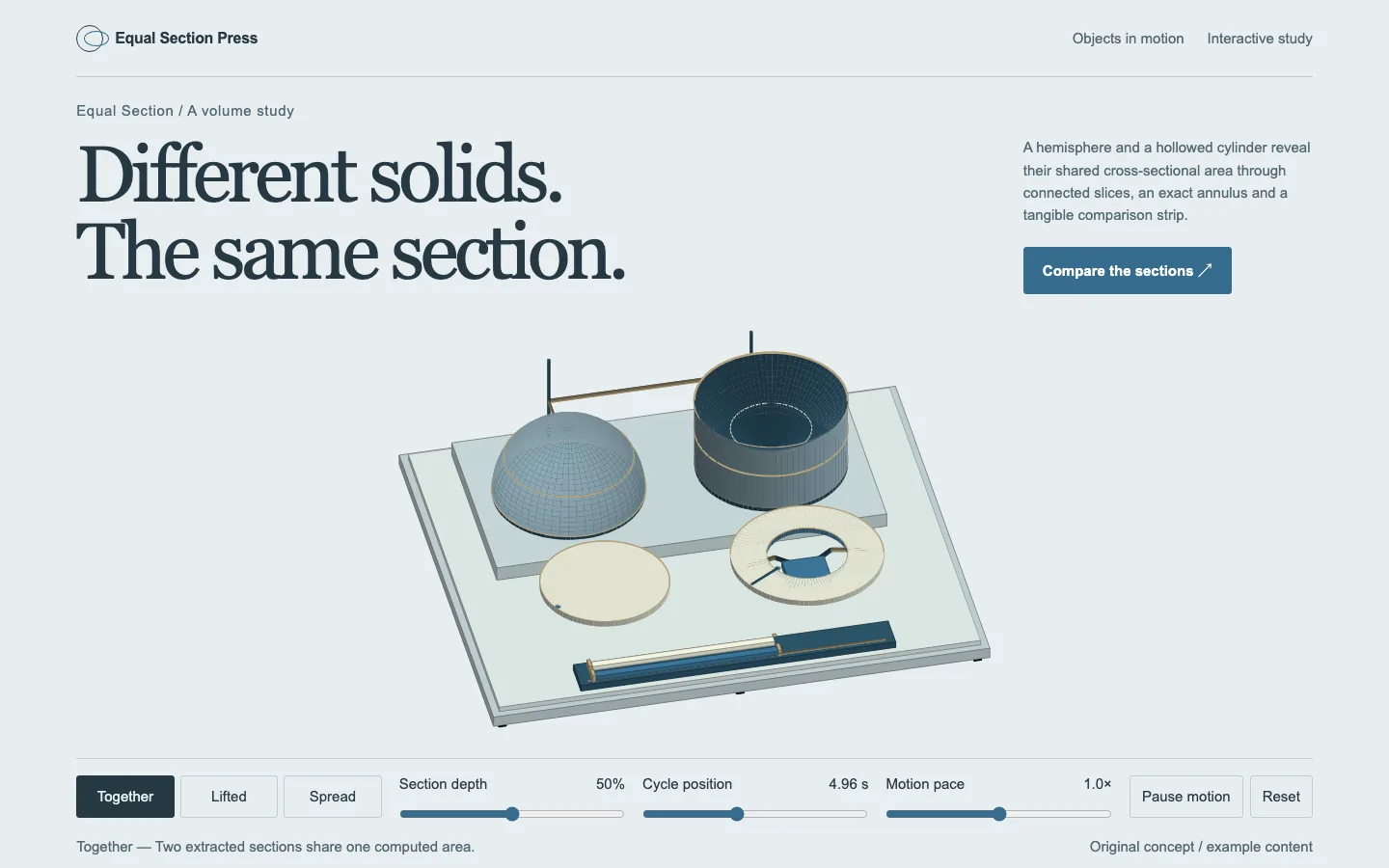
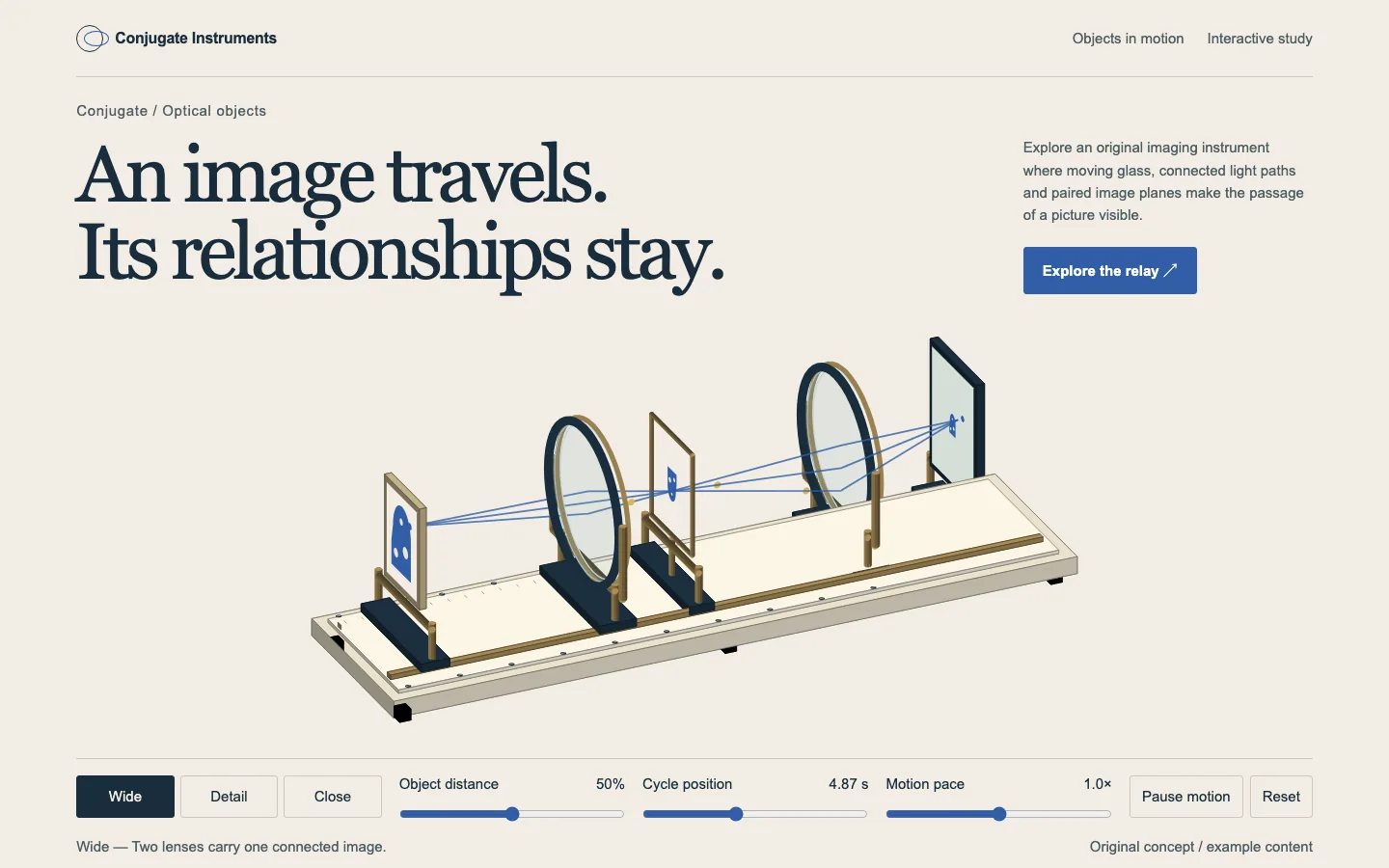
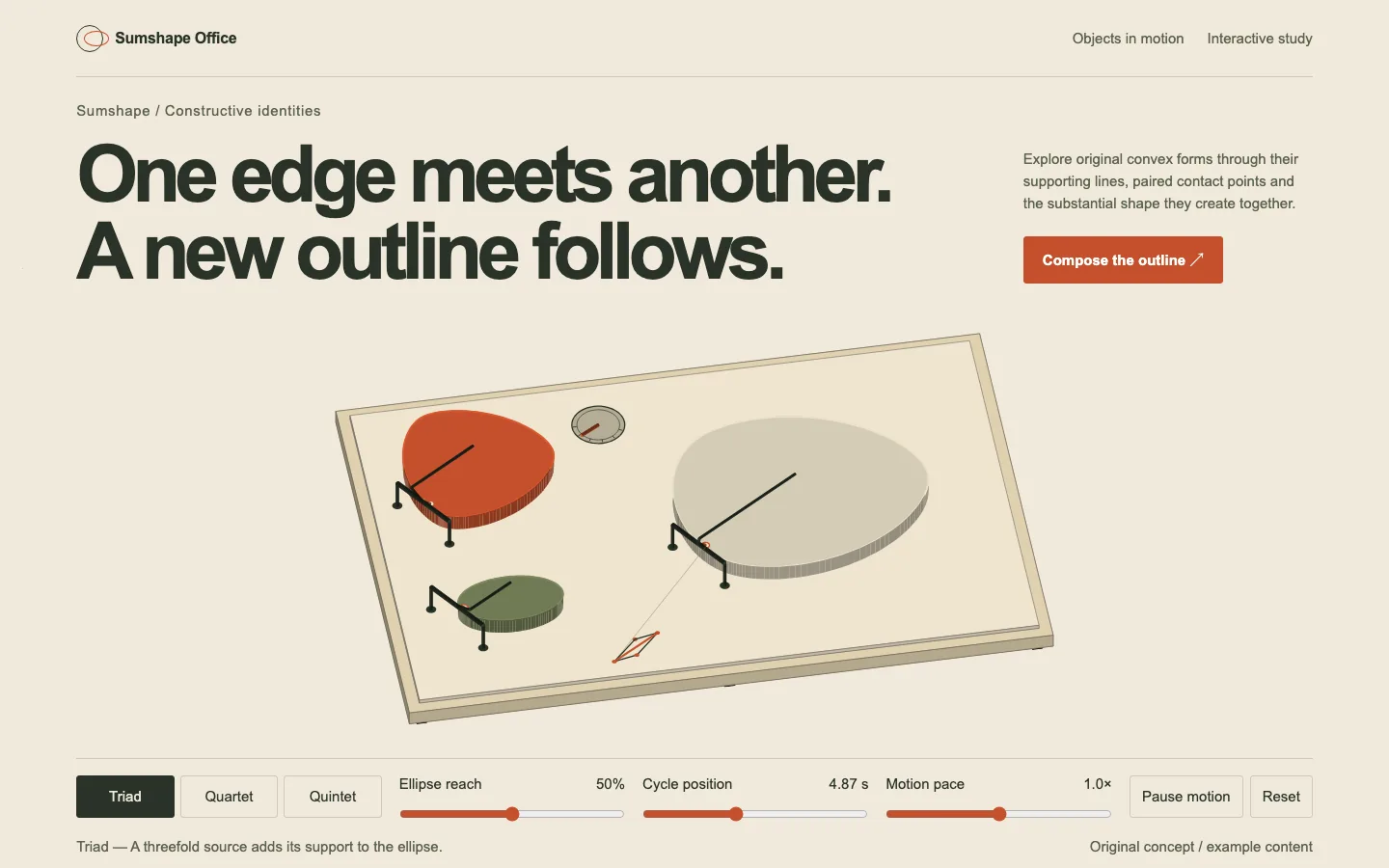
Create two large ceramic mosaic disks on a low stepped limestone plinth, one slightly higher and farther back than the other. Each disk has a thick dark sidewall, an ivory bevel and an uninterrupted outer rim. The source disk contains an original asymmetric composition of ochre, petrol and bone cells formed by a clipped Cartesian lattice inside radius 0.90. Use a finite set of straight source edges and sample each shared edge consistently; include one broad L-shaped color region and two offset curved color accents so the composition has no rotational symmetry. The receiver disk carries the exact transformed boundaries of those same cells, drawn as filled curved patches with engraved seams. For complex source coordinate z, use F(z)=(z-c)/(1-conj(c)z). State direction vectors are exp(iγ) for γ=0, 2π/3 and 4π/3; blend their real and imaginary components from the current display. Let c=a*v+0.025 exp(iψ). Do not renormalize a blended v, since the identity-like passage between directional emphases is valid. A small physical eccentric compass between the disks shows c within a complete bounded ring, with its center pin attached to a radial slot. A source probe moves on z=0.58 cosψ+i0.44 sinψ. Its receiver probe lies exactly at F(z), connected by a fine tether that passes above both rims. At each probe draw a short tangent cross. Map its directions with F′(z)=(1-|c|²)/(1-conj(c)z)², so the receiver cross rotates and scales while retaining a right angle. A low scale strip repeats these two finite tangent lengths as solid raised bars. Add two further correspondence pins on fixed source features to make the global change readable. Give the plinth complete rear faces, two disk cradles and a soft grounded shadow. Depth-sort rear cells, rims, correspondence tethers and front compass hardware; retain all disks, tethers and scale bars inside the padded art envelope at maximum pull.

LAYOUT AND TYPOGRAPHY
Use a premium identity-studio landing spread with the headline in a large left-aligned top band and the two mosaic disks forming a bold diagonal below it. Place the body and ochre action in a narrow right column, aligned with the higher disk rim. Let the mosaic colors and changing curved seams provide visual richness; avoid gradients, floating UI cards and fabricated case-study metrics. A small original offset-cross mark anchors the masthead. Keep the full stepped plinth above a generous desktop control dock. On phones, stack copy and a substantial art stage with the source disk above-left and receiver below-right, keeping their correspondence tethers within the same view. Preserve all compass and scale-strip parts with at least 8px internal clearance.

CHOREOGRAPHY
Use the deterministic 12-second clock ψ=2πt/12. The small orbit in c continuously deforms the complete receiver mosaic while the source probe follows its own elliptical route. Its mapped probe, derivative cross and scale strip respond to the same map, creating two coordinated visible systems. The three fixed correspondence pins reveal global movement even when the traveling probe is near a locally quiet region. At all quarter phases the denominator remains bounded and every mapped cell remains inside the receiver disk. Interpolate the complex state direction vector over 900ms from the CURRENT blend, then recompute F and F′; do not crossfade finished mosaics or renormalize the interpolated vector. Keep one source disk and one receiver. The mapping-pull slider changes the whole construction at a frozen clock. Pause or reduced motion settles the selected state and freezes all movement and highlights; hidden documents suspend an unfinished transition until resumed. No separate CSS timing is allowed.

DELIVERABLE AND CONTENT
Produce a complete, runnable index.html with inline CSS and JavaScript. This is an original fictional brand concept for a free design-prompt library. Use the brand and copy supplied above, not any other site's wording. Do not add testimonials, fabricated statistics, paywalls, account forms, model names or irrelevant pipeline details. The only external resource permitted is an optional Google Font; a strong system stack is preferred. Procedural live art is the deliverable, so do not substitute screenshots, images or videos for it.

LAYOUT AND TYPE
At 1440x900 the composition is a single cinematic frame with a real header, nav, main and footer. Reserve about 80px for header, 110px for controls, and the remainder for the hero and scene. Use a maximum content width of 1320px and 5.5vw outer gutters. Text is a separate semantic HTML layer above an aria-hidden full-viewport canvas. Keep body copy at least 15px, muted text contrast readable, and the main headline between 64 and 104px at desktop. At widths below 760px use 24px gutters, a 42-54px headline and a real vertical flow. Hide optional desktop navigation, not the title or primary action. Let the page scroll vertically on small screens when controls need space. Never crop a headline to satisfy the desktop composition.

WORKING INTERACTIONS
Use the primary action to focus or open the selection area, not to navigate to a fake app. Three visible choices switch the scene's meaningful state and update a live caption. Set aria-pressed on the selected choice. Include Pause motion / Resume motion and Reset buttons. Reset restores the first choice, neutral pointer and initial composition. All buttons work with keyboard. Show a clear focus ring, preserve ordinary cursor behavior and make touch targets at least 44px. Add a brief footer disclosure that this is a concept demo with example content.

MOTION AND PERFORMANCE
Use one requestAnimationFrame loop, performance.now deltas, cached dimensions, a capped devicePixelRatio of 1.5, and deterministic seeded geometry. Never read layout inside a hot drawing loop. Use a ResizeObserver or resize handler to update canvas dimensions and cached positions. Use pointermove only to update target values; ease the targets in the animation loop. Draw all visual motion in Canvas or transform/opacity, not layout properties. On document.hidden skip expensive painting; resume without a large time jump. Honor prefers-reduced-motion both at startup and when the preference changes: freeze continuous motion, remove entry translation and keep content and selectors usable. The pause control must correspond to visible motion. Maintain window.__DEMO__ readiness, frames, effects, errors and selected state so the example can be checked.

FAILURE GUARDS AND REVIEW
Initialize the canvas and draw an attractive first frame even if motion is disabled. Keep HTML text and actions visible if JavaScript fails. A scene must never be required to read the copy. Test 390x844, 768x1024, 1024x640 and 1440x900; test pointer movement, each scene option, pause, reset, keyboard focus and reduced motion. Confirm one h1, named controls, real semantic landmarks, no horizontal document overflow, no console errors and no failed resources. Keep all colors in the supplied family. Include no external image, animation, icon or UI framework dependency. Return the entire HTML file, without placeholders or omitted code.


COPY-AND-PASTE REPRODUCTION CONTRACT
The complete prompt is the only input. Do not require an attached image, prior chat,
repository, local file, API key, remote image, external script or font download.
Use only inline HTML/CSS/JS and local system fonts. All art must be your own procedural
implementation of the brief. The result must work offline from file://.

Use these exact stable hooks so the output can be independently tested:
- One aria-hidden canvas spanning the full viewport width; clip its drawing to a
  dedicated .visual art region whose bounds you cache on resize. Never overlap text.
- Exactly three real buttons with data-choice="0", "1", "2" inside #choices.
  aria-pressed reflects the selection. A visible #caption with role="status" includes
  the full selected label plus a short explanation.
- #explore is the main CTA; it focuses [data-choice="0"] and scrolls the controls into
  view. It must not open a fake app or submit information.
- #pause toggles Pause motion / Resume motion and aria-pressed. It freezes every pixel
  of all continuous effects and stops the requestAnimationFrame loop after one paint.
  Do not leave CSS, timers, eye blinks, shaders, particles or reflections running.
- #reset restores selected=0, the initial clock, neutral pointer, and pace=1, while
  preserving whether playback is paused. It renders that complete initial arrangement.
- #pace is a labeled, keyboard-accessible range input min=.5 max=1.5 step=.1 value=1,
  with visible #pace-value output. It scales the accumulated animation clock.
- window.__DEMO__ must additionally expose selected (number), paused (boolean),
  speed (number), clock (number) and transition (0..1 blend, 1 when settled).
  Keep those fields current after every action. Start ready only after actual drawing.

State timing: on a running selection, save the previous state and start a ~900ms blend;
interpolate or crossfade as the design requires, with visible intermediate frames.
While paused or reduced-motion is active, choices update the complete selected still
immediately. Pausing settles any in-progress transition, then stops all further frames.
Respect reduced motion at startup AND on media-query changes; avoid animated entrance
effects then. Selection, Reset and resize may request one frame while paused, followed
by silence. Cache resize observations so that they do not cause an endless paint loop. When sizing an absolute canvas, measure the actual content wrapper, excluding the canvas itself; stale canvas height must never keep the desktop page at its previous mobile height.
Compute dt from requestAnimationFrame timestamps and cap it at 40ms. Reset the previous
timestamp when resuming. Keep the DOM readable even if drawing fails.

Layout: desktop 1440x900 must fit in one viewport. At 768x1024 and 390x844, use real
vertical flow when needed, with controls visible by scrolling and no horizontal overflow.
Do not hide the pace control on tablets. Every button must have BOTH min-width:44px AND min-height:44px; prevent flex shrinking from reducing either dimension. Give the
art enough scale to remain recognizable on phones, and avoid clipping long headings.
Use roughly 80px header and 120px footer at desktop; reserve the rest for copy and art.
Do not spend the composition on empty space or shrink the artwork into a tiny diagram.
Keep body/dock text contrast >=4.5:1; use the supplied muted color rather than low opacity. Never fade meaningful text with opacity. Preserve readable labels and 15px body text.
Use an original small brand mark, deliberate typography, one primary action and clean
controls. Include a brief 'Original concept / example content' disclosure.

Before returning, internally check script syntax, initialization order, correct canvas
scaling after resize, all three state geometries, pause/resume, Reset, keyboard focus,
reduced motion and mobile sizing. Return the complete working HTML without placeholders.


FINAL LAYOUT CROSS-CHECK
Leave enough internal padding around the h1 for glyph ascenders and descenders.
At 390x844, 768x1024, 1024x640 and 1440x900, both scrollWidth and scrollHeight of
the heading must fit its client dimensions within 2px. Do not clip typography
to achieve this. Reflow or reduce type at intermediate widths where needed.
Check a mobile-to-desktop resize sequence, not just fresh loads. Keep every
specified object complete inside its art region and all controls reachable.
For three-dimensional scenes, draw complete shaded faces and correct occlusion;
thin wireframes or floating disconnected parts must not replace solid objects.
Each selected state needs its own complete composition, recognizable when paused.

ADVANCED SCENE AND INTERACTION CONTRACT
Use the Canvas2D API (CanvasRenderingContext2D) for the procedural scene.
This is a complex but coherent procedural composition. Build all named assemblies
and preserve their actual causal relationships, including during transitions.
Assemblies: Thick source mosaic disk with asymmetric ceramic cells; Thick receiver disk with mapped curved cells; Eccentric mapping-center compass; Paired source and receiver tangent crosses; Three correspondence tethers with pin joints; Local scale comparison strip; Shared stepped display plinth and disk cradles.
Coupled relationships: Every receiver cell boundary is the exact image of a matching source boundary under one shared complex map.; Both tangent crosses are related by the complex derivative, preserving their right angle while rotating and scaling.; The mapping-center compass and moving probe use the same c and F as the complete receiver mosaic..
Prevent these concrete failures: Enforce the 0.565 maximum center magnitude and 0.90 source radius so no denominator approaches zero or point escapes the unit receiver.; Sample shared cell edges once and reuse them on both neighboring faces, preventing cracks or overlaps in the mapped mosaic.; Render the receiver as filled ceramic patches with fine engraved seams; do not replace the nonlinear cell geometry with a texture crossfade..

INDEPENDENT GEOMETRY CONTROL
Visible user label: Mapping pull
Required geometric behavior: Use a=0.12+0.42p, producing 0.12, 0.33 and 0.54 at 0%, 50% and 100%. The selected state supplies a unit direction vector v; set c=a*v+0.025(cosψ+i sinψ). Apply F(z)=(z-c)/(1-conj(c)z) to every source sample. The slider changes the control-center position, all mapped cell boundaries, mapped probe position and local tangent scale in every state. For |z|≤0.90 and |c|≤0.565, the denominator magnitude is at least 0.4915. The derivative (1-|c|²)/(1-conj(c)z)² never vanishes, preserving orientation and local angles. The source and receiver disks remain finite and complete even during convex blends of the state directions.
Use #parameter, a real labeled range input min=0 max=100 step=1 value=50.
Show its percentage in #parameter-value. Expose the numeric value as
window.__DEMO__.parameter. It must visibly change the actual canvas geometry in
ALL three states, with coherent valid endpoints at 0,50,100. Changing it while
paused must repaint once without advancing clock or resuming playback. Use
bounded mappings that never disconnect joints, invert faces or collapse objects.

CYCLE INSPECTION
The whole scene runs on one deterministic 12 second periodic clock. Use #phase, a
real labeled range min=0 max=12 step=0.01 value=0, labeled 'Cycle position', with
visible #phase-value in seconds. Expose window.__DEMO__.cycleSeconds=12.
When this slider receives input, pause playback, settle any state transition,
set clock to the requested seconds, update the actual composition and render
once. Clock 12 is the same loop boundary as 0. While playing, keep this slider and
its readout synchronized with clock modulo 12. All motion must derive from that
clock: shafts, moving material, riders, lighting, reflections and smaller parts.
Scrubbing to 0, 3, 6, 9 and 11.99 seconds must produce valid, visibly moving states.
The independent geometry parameter is preserved when selecting a state or
scrubbing. Reset additionally restores parameter 50 and cycle position 0 while
preserving whether playback is paused. Keyboard Arrow keys work on both sliders.

CONTINUITY AND RELIABILITY
Use one stoppable requestAnimationFrame loop, no timers or independent CSS motion.
Select a new state by interpolating actual shared geometry from the CURRENT
visible configuration over 900ms, even when the previous transition is unfinished.
Do not crossfade two copies of a shared machine, landmark or scene. Independently
appearing/disappearing objects may fade. Keep joints, contacts, material routes,
supports and printed surfaces attached during all intermediate configurations.
Pause settles the selected state and stops all frame requests; parameter, scrub,
resize and selection may request exactly one paused repaint. On document.hidden
cancel the loop. On visibility restoration, reset the timestamp before resuming
so no large time jump occurs. Zero NaN/Infinity geometry or stale resize state.

GEOMETRY FRAMING AND INSPECTION
Compute scene bounds from projected geometry for every paint, before clipping;
do not use the viewport itself as a fake object bounding box. Expose conservative
primary-object bounds as window.__DEMO__.artBounds={x,y,width,height} and the
cached clipping region as window.__DEMO__.artRegion={x,y,width,height}, both in
CSS document coordinates. Include full silhouettes, attached parts and material
routes. The region must enclose artBounds with at least 8 CSS px margin at every
state, parameter 0/50/100, cycle phase and tested viewport. Camera fitting must use
all possible extents, avoiding sudden zooms when only a small part moves.
Keep the canvas transparent outside actual procedural artwork. Do not fill the
entire art region with a rectangle to hide clipping. Backgrounds belong in CSS.
Diffuse shadows may extend beyond primary bounds, but opaque scene geometry may
not touch the clipping boundary. Never read pixels/layout inside a hot draw loop.

FINAL PRODUCT CHECK
Give the larger control dock enough space. Reserve fixed widths for changing
readouts so control updates never resize the artwork or shift the page. All body, caption, button and slider
labels/readouts are at least 15px with contrast>=4.5:1. Every button remains at
least 44×44px and the Reset label has real internal padding. At 1440×900 fit one
viewport; at 390×844, 768×1024 and 1024×640 use real flow with all controls reachable.
Preserve literal spaces between heading spans; visible and accessible copy must
match exactly. Draw complete correctly occluded solid objects, not disconnected
lines. Make at least two coupled moving systems visibly active, not just a clock
counter or imperceptible highlight. Test rapid 0→2→1 state changes, mid-blend Pause,
Reset, parameter extremes, every quarter-cycle, reduced motion and mobile→desktop
resizing. Confirm the fully paused image is stable. Return complete offline HTML.


---

TECHNICAL CONTRACT (non-negotiable):

1. Deliver ONE single file: a complete, valid `index.html`. No build step, no bundler,
   no framework, no package install. It must open correctly by double-clicking the file
   and also over http://.
2. Vanilla only. No React, no Tailwind CDN, no GSAP, no Three.js, no jQuery, no Lottie.
   Plain HTML + CSS + modern JavaScript in <style> and <script> tags.
3. NO external media. No .mp4, no .webm, no .gif, no remote images, no base64 blobs of
   photos. Every visual must be generated procedurally with CSS gradients, SVG, or
   <canvas>. This keeps the page free to host and impossible to break with a dead link.
4. Google Fonts is the ONLY permitted network request, and it must be declared with a
   <link rel="preconnect"> plus a system-font fallback stack so the page still looks
   intentional offline. If you prefer, skip it and use a pure system stack.
5. Responsive and correct at 390x844 (phone), 768x1024 (tablet) and 1440x900 (desktop).
   No horizontal scrollbar at any of those widths. Nothing may overflow its container.
6. Accessibility: exactly one <h1>; real <header>/<main>/<footer>/<nav> landmarks; every
   interactive element is a <button> or <a> with an accessible name; visible :focus-visible
   ring; body text contrast ratio >= 4.5:1 against its background.
7. Motion safety: wrap all continuous motion in
   `@media (prefers-reduced-motion: reduce)` rules that reduce it to a static or
   near-static state. The page must remain fully readable and usable with motion off.
8. Performance: no layout thrash. Cache DOM reads, batch writes inside a single
   requestAnimationFrame loop, use transform/opacity for animation, and never allocate
   inside the hot loop. Target 60fps on a 2019 laptop. Total file under 90 KB.
9. Runtime telemetry hook (used by the automated verifier — implement it exactly):
   at the top of your script define
     window.__DEMO__ = { name: '<slug>', ready: false, frames: 0, effects: [], errors: [] };
   then set `ready = true` after the first paint of your main effect, increment
   `frames` once per animation frame inside your rAF loop, and push the name of each
   implemented effect into `effects`. Add a `window.addEventListener('error', ...)`
   handler that pushes messages into `errors`. Do not rename these fields.
10. Zero console output in the happy path. No console.log left behind. No uncaught
    exceptions, no failed network requests.

RESPONSE FORMAT:
Return ONLY the raw HTML inside a single ```html fenced code block. No explanation, no
preamble, no commentary before or after the fence. The file must be complete and
immediately runnable — never truncate, never write "// rest of code here".
Keep exploring